
Have you ever wondered what makes a Yixing teapot so special that these humble clay vessels have been treasured by tea connoisseurs for over five centuries? It is not merely their earthy beauty or the satisfying weight in your hands—it is the remarkable way they transform the tea itself, enhancing aroma, deepening flavour, and developing a living patina that tells the story of every brew poured through them.
Yixing teapots, also known as Zisha (purple sand) teapots, originate from the city of Yixing in China‘s Jiangsu province. Made from a unique, unglazed clay found only in this region, they are widely regarded as the finest vessels for brewing tea. Unlike mass-produced ceramics, each authentic Yixing teapot is largely handmade by skilled artisans, making every piece as unique as the tea it brews. In this guide, we will explore the history, craftsmanship, and enduring allure of the Yixing teapot—and explain why the right vessel can transform your tea ritual into something truly transcendent.
Table of Contents
The History of the Yixing Teapot
What is Zisha Clay?
The Art of Yixing Teapot Craftsmanship
Types of Yixing Teapots: Shapes and Styles
Why Use a Yixing Teapot? The Benefits
Health Benefits of Brewing with a Yixing Teapot
How to Choose Your First Yixing Teapot
How to Season and Care for Your Yixing Teapot
The Cultural Significance of Yixing Teapots
FAQ
Conclusion
Find Your Perfect Yixing Teapot at Dynasty Artisan
Research and References
1. The History of the Yixing Teapot
The story of the Yixing teapot begins long before the pots themselves took their iconic form. Pottery has been made in the Yixing region since Neolithic times, and during the Song Dynasty (960–1279), potters near Yixing were already producing distinctive vessels.
However, according to tradition, the first true Yixing teapot was created in the early 16th century by an anonymous monk living at Jinsha Temple near Yixing. This marked the beginning of a craft that would soon captivate the nation. By the Wanli period (1573–1619), there was a steady stream of known potters, and Yixing ware was already being praised as artistic treasures that were both practical and aesthetically pleasing.
In the 17th century, small Yixing teapots were sent by the Dutch East India Company with tea shipments to Holland, introducing Europe to these remarkable vessels. They went on to provide models for the earliest Dutch, German and English teapots. Today, the Yixing purple clay teapot remains one of China‘s most revered cultural treasures, with its making techniques recognised as a national intangible cultural heritage.
2. What is Zisha Clay?
Zisha—which translates to “purple sand”—is the unique clay found only in the Yixing region of Jiangsu province. What makes this clay so extraordinary is its granular and porous structure, which gives Yixing teapots their legendary ability to enhance tea.
Zisha clay can be split into three main types:
Purple clay (Zini): The most common type, with a high iron content that fires to a purple-brown colour.
Red clay (Zhuni): A rarer, finer clay that fires to a rich red hue.
Green clay (Lvni): A lighter clay that fires to a greenish-brown or beige colour.
These clays are taken from local rock mines and processed without artificial additives or chemical glazes. The result is a natural, unglazed ceramic that allows the tea to “breathe” while absorbing the oils and aromas of each brew.
3. The Art of Yixing Teapot Craftsmanship
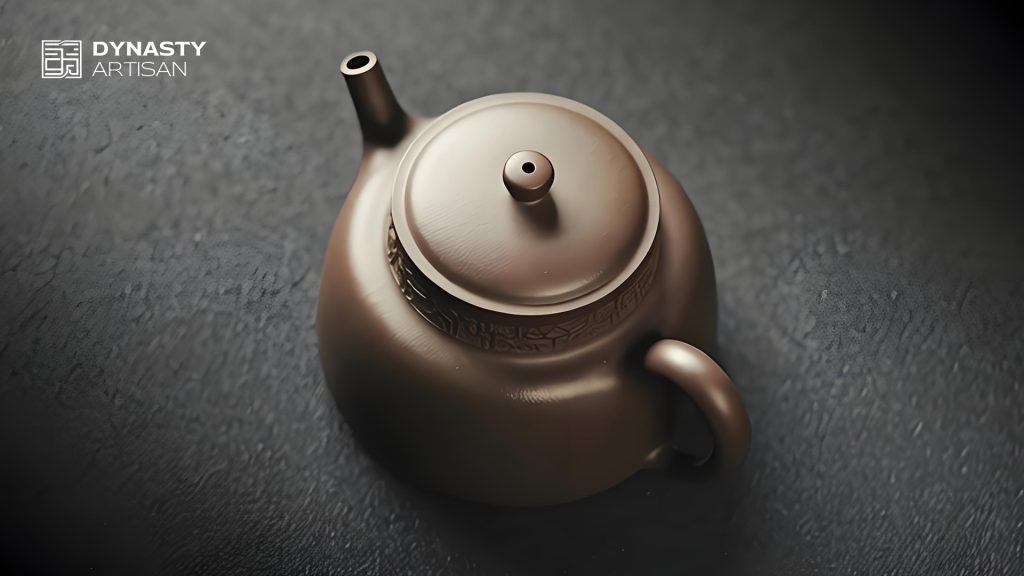
Authentic Yixing teapots are largely handmade, a process that requires years—sometimes decades—of training. Craftsmen use over 100 custom-made tools and follow a meticulous sequence of steps: preparing the clay slabs, shaping the body, surface finishing, and carving decorations.
A hallmark of an authentic Yixing teapot is its slightly bumpy and imperfect texture. Unlike mass-produced pots made with molds, a handmade pot will lack visible centre lines and will bear the subtle marks of the artisan‘s hands.
This dedication to craftsmanship is what elevates the Yixing teapot from a mere utensil to a work of art. Each pot is a unique expression of the maker’s skill and vision, carrying forward a tradition that has been refined over centuries.
4. Types of Yixing Teapots: Shapes and Styles
Yixing teapots come in a remarkable variety of shapes and styles, broadly categorised into two families:
Round teapots: Made in the shape of balls, bellies, drums, and even garlic cloves.
Square teapots: Tapered or moulded into polygons, rhombuses, or trapezoids.
Beyond these basic forms, Yixing teapots are also classified by their design philosophy. Some are simple and unadorned, reflecting the aesthetic tastes of scholars and literati. Others are elaborately carved with poems, landscapes, or floral motifs, showcasing the artisan‘s decorative skills.
Regardless of the style, all Yixing teapots share one common trait: they are traditionally small in size, typically designed for 2–4 people. This is because they are intended for multiple short infusions—the preferred method for brewing fine oolong, pu-erh, and black teas.
5. Why Use a Yixing Teapot? The Benefits
What makes a Yixing teapot superior to other teapots? The answer lies in the unique properties of Zisha clay.
First, the porous structure of Zisha clay allows the teapot to absorb the oils and aromas of the tea brewed in it. Over time, the pot becomes “seasoned”—developing a patina and a memory of every brew. This is why serious tea drinkers dedicate each Yixing teapot to only one type of tea (e.g., one for oolong, one for pu-erh), allowing the pot to enhance and deepen the flavour of that specific tea with each use.
Second, the double-pore structure of the clay makes the tea fully breathable. This means the tea stays fresh longer and does not deteriorate quickly, even in warm weather.
Third, Yixing teapots are unglazed, allowing the tea to interact directly with the clay. This interaction, combined with the clay‘s mineral composition, is believed to produce a tea infusion that is less bitter, more fragrant, and richer in healthful compounds.
6. Health Benefits of Brewing with a Yixing Teapot
Beyond the sensory experience, brewing tea in a Yixing teapot may offer tangible health benefits.
A scientific study comparing different teapot materials found that Yixing clay pots produce tea infusions that are less bitter, more fragrant, and tend to contain more healthful compounds than tea from other pots. The unique composition of Zisha clay not only benefits the taste of the tea but also its healthfulness.
Some sources suggest that the high iron content in Zisha clay can supplement the iron needed by the human body. Others claim that water brewed in a Yixing teapot becomes slightly alkaline, which over time may help improve the body’s acid-base balance. The clay is also free from chemical glazes or artificial coatings, making it a natural and healthy choice for brewing.
While more research is needed to confirm these specific health claims, there is no doubt that the Yixing teapot elevates the tea-drinking experience—and any practice that encourages mindful, daily tea consumption is a practice that supports wellbeing.
7. How to Choose Your First Yixing Teapot
If you‘re new to Yixing teapots, the sheer variety can feel overwhelming. Here are some practical tips to guide your choice:
Prioritise clay quality over fancy carvings. For beginners, focus on pure, unblended Zisha clay. Zhuni (red clay) or Duanni (greenish-brown) are excellent starting points.
Keep the shape simple. A classic round or simple square shape is both versatile and easier to care for.
Choose the right size. A medium-sized teapot (around 150–250 ml) is versatile for 1–3 people.
Look for signs of handcrafting. Authentic Yixing pots have a slightly bumpy texture and lack visible centre lines.
Consider your tea. Different teas pair better with different clays, but as a general rule, Shou Pu‘er, Oolong, and Black teas are most commonly brewed in Yixing teapots.
8. How to Season and Care for Your Yixing Teapot
Seasoning—also known as “opening” a new teapot—is an essential step that prepares the clay for brewing. Here is a simple method:
Rinse the teapot inside and out with fresh water.
Boil the teapot in a pot of clean water for about 10–15 minutes. Use a cloth or wire ladle to prevent it from touching the bottom.
Brew a strong infusion of the tea you intend to dedicate to the pot. Pour the tea over and through the pot, then discard.
Repeat the brewing and discarding process 2–3 times.
Daily care is equally important:
After each use, remove the tea leaves and rinse the teapot with hot water only.
Use a clean tea cloth to wipe the surface dry.
Place the teapot upside down to air dry completely before storing.
NEVER use soap or detergent to clean a Yixing teapot. The porous clay will absorb the chemicals, ruining the flavour of your tea forever.
9. The Cultural Significance of Yixing Teapots
The Yixing teapot is more than a brewing vessel—it is a cultural icon. In old China, owning a clay teapot was even a symbol of social status. Dating back to the 15th century, Chinese artists and intellectuals began to be involved in making teapots, composing poems and inscribing them on their creations.
Today, Yixing teapots remain an integral part of the Chinese tea ceremony. They are often exquisite works of art, displaying some of the finest craftsmanship in pottery. Yet, beyond their lovely exterior and classic colour, they are also deeply functional.
As one writer put it, Yixing teapots “bring with them the spirit of the Earth, the art of tea and the simplicity of true living”. They invite us to slow down, to appreciate the moment, and to connect with a tradition that spans centuries.
10. FAQ
Q: What is a Yixing teapot?
A: A Yixing teapot, also known as a Zisha or purple clay teapot, is a traditional Chinese teapot made from a unique, unglazed clay found only in the Yixing region of China.
Q: Why are Yixing teapots so special?
A: Their porous clay absorbs the oils and aromas of tea, enhancing flavour with each use. They are also prized for their craftsmanship, beauty, and the belief that they produce a healthier, more flavourful tea infusion.
Q: Can I use a Yixing teapot for any tea?
A: Most serious tea drinkers dedicate each Yixing teapot to one type of tea (e.g., oolong, pu-erh, or black tea). This allows the pot to develop a seasoning that enhances that specific tea.
Q: How do I clean a Yixing teapot?
A: Rinse with hot water only after each use. Never use soap or detergent.
Q: How do I season a new Yixing teapot?
A: Rinse it, boil it in water for 10–15 minutes, and then brew a strong infusion of your chosen tea 2–3 times, discarding the tea each time.
11. Conclusion
The Yixing teapot is far more than a kitchen utensil. It is a living vessel that grows with you, absorbing the memory of every tea you brew and developing a patina that tells your story. It is a testament to the enduring power of human craftsmanship—a craft that has been refined over centuries and recognised as a national intangible cultural heritage.
From its unique Zisha clay to its rich history and cultural significance, the Yixing teapot invites us to slow down, to savour, and to connect with a tradition that has nourished body and spirit for generations. When you brew with a Yixing teapot, you are not just making tea—you are participating in a ritual that honours the art of tea itself.
12. Find Your Perfect Yixing Teapot at Dynasty Artisan
A truly exceptional tea deserves a vessel that honours its depth and complexity. That is why we at Dynasty Artisan are proud to offer a curated collection of handcrafted teapots that carry the soul of ancient craftsmanship into your daily life.
Our Handmade Teapots are not moulded by machines—they are shaped by skilled hands, glazed with unique recipes, and fired with meticulous care. Whether you are seeking your first Yixing teapot or adding to a growing collection, you will find pieces that resonate with your personal story and elevate every sip.
Explore our collection of Yixing Teapots and discover the joy of brewing from a piece made for you, not for a conveyor belt. Your tea ritual deserves that texture, that weight, that beauty. Your hands—and your soul—will thank you.
13. Research and References
-
“Yixing ware.” Art Gallery of New South Wales.
-
“Yixing clay teapot.” The Free Dictionary.
-
“Ancient Yixing purple clay pottery experiences modern revival.” (2024). People‘s Daily Online.
-
“Yixing purple clay pottery-making technique.” (2025). Wuxi Government.
-
“Yixing breathes new life into zisha teapots.” (2024). China Daily.
-
“Effect of teapot materials on the chemical composition of oolong tea infusions.” (2017). PubMed.
-
“Yixing clay teapot, the essence of Chinese art.” (2019). China Story.
-
“So You Want Your First Yixing Teapot? Let’s Do This Right.” (2025). World Taobao.